

Boot fitting in Folgarida: what it is, how it works, and why it's changing the way you ski.
There's one thing a good portion of skiers have in common, from beginners to experts: they've finished the day with shattered feet at least once. Numb toes, aching ankles, pressure on the shins that becomes unbearable after four hours. They blame their boots—too hard, too tight, too much of something. And the next year, it's all over again.
The problem, almost always, isn't the boots. It's that they've never been adapted to the wearer's foot.
Ski boot fitting in Folgarida is available directly at Malghet Aut by Promescaiol—no need to go down into the valley, no need to make appointments at specialized shops far from the slopes. If you notice something isn't right during the week, you're already in the right place.
A clarification worth making right away: boot fittings are performed exclusively on your own boots. We never work on rental boots—every adjustment physically modifies the boot, and what fits one foot won't fit the next. Those who rent from Promescaiol, however, benefit from a digital scanner, which automatically identifies the boot best suited to their foot shape from those available in the fleet.
What is ski boot fitting — a straightforward explanation?
Boot + fitting. The concept is simple: you customize the ski boot to the wearer's specific foot, rather than hoping that a standard last will closely match the morphology of that foot.
Every foot is different. Length, width, instep height, arch, position of the ankle, asymmetry between left and right—no two feet are the same. Ski boots, on the other hand, are mass-produced on standard lasts. The result is that most skiers wear something that's "more or less" the right size—but never a perfect fit.
Pressure points, pain, poor sensation, loss of control when turning, cold infiltrating where the boot doesn't fit. These are all symptoms of the same problem: the boot isn't made for your foot. Boot fitting closes that gap.
The first step: foot analysis with a digital scanner
Before touching the boot, the foot is measured. At Promescaiol, a digital scanner is used to capture the three-dimensional shape of the foot in just a few seconds: length, width, instep height, weight distribution, and any asymmetry between the left and right foot. In some cases, the analysis is supplemented with manual tools—podoscopes, visual assessment of posture—depending on the situation.
But technology is just the starting point. A digital scanner without a competent boot fitter is a useless tool. It's the objective data in the hands of someone who knows how to read it that produces real results—not the machine alone.
From that data, specialized personnel determine which boot is best suited and where to adjust. There's no trial and error—they start with precise measurements, and the difference in the final result is noticeable.
What does boot fitting include: the concrete phases of the work
After the analysis, the boot fitter evaluates the specific situation and decides on the necessary interventions. There's no one-size-fits-all protocol—the work is based on the individual's specific foot.
Selecting the right boot comes first
Before any modification, you need to choose the right boot. Volume, width, plastic hardness (flex), and liner shape are variables that vary radically from model to model and must match the morphology of your foot and your skiing level. With the scanner's data, this choice becomes objective rather than empirical.
It's worth stating clearly: many customers arrive with boots that are the wrong size. And almost always, the problem isn't that the boot is too small—it's too big. One or two sizes larger than what you need. It may seem counterintuitive, but that's what happens when you buy a boot without a professional assessment: you choose a "large" size to be safe. The result is a foot that floats inside the boot, losing control, and compensating with movements that the boot can't transmit to the skis.
If your boot is a size and a half or two too large, the most effective solution is to buy a new one in the correct size. There's no technical solution that can fix a structurally oversized boot. An honest boot fitter will tell you right away, before making you spend money on work that doesn't solve anything.
Thermoforming of the inner shoe
The inner boot is heated and molded directly to the foot. The result is a fit that hugs the exact shape of that foot—eliminating the gaps that cause cold and the pressure points that cause pain.
External hull modification
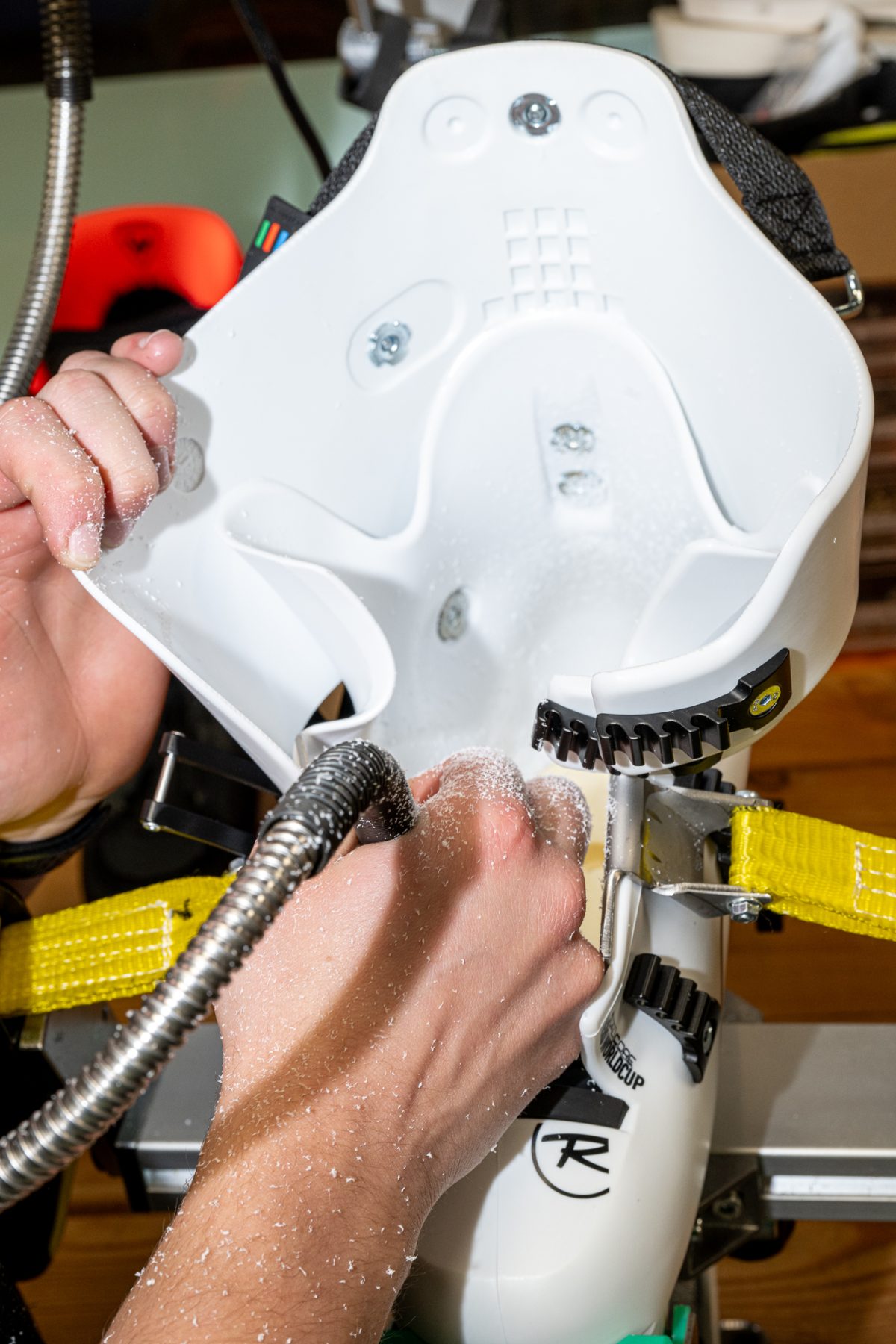
When the original shape of the plastic isn't suitable—hallux valgus, bony prominences, particularly pronounced malleoli—the shell is widened in specific areas through doming or milling. The material is removed or expanded exactly where needed, without compromising the structure of the boot.
Custom insoles
The standard ski boot insole is flat and generic. A custom insole supports the arch in its specific shape, improves weight distribution, and increases contact with the liner. More control in turns, less muscle fatigue throughout the day.
For athletes and ski instructors there are more advanced processes - structural modifications to the plastic, injected liners - but that is another matter, for those who require a level of transmission precision that goes beyond amateur use.
What really changes: the concrete benefits of boot fitting
No more pain. This is the most immediate benefit. Boot fitting eliminates pressure points, chafing, blisters, and black toenails. A properly fitting boot doesn't hurt. Anyone who's always thought that "ski boots always hurt a little" has never worn boots that fit their feet.
Warm feet. A poorly fitting boot leaves gaps where body heat escapes. A properly fitted boot eliminates those gaps—keeping your feet warm even on the coldest days.
Greater safety on the slopes. A poorly fitted boot doesn't properly transmit the foot's impulses to the skis. The foot seeks out movements that the boot can't accommodate—imprecise steering, delayed response. A well-fitted boot translates every movement into an immediate response from the skis.
Actual performance, not theoretical performance. Boot fitting doesn't increase performance—it reveals it. With an ill-fitting boot, the skier is never expressing his or her full potential: the foot continually compensates, losing energy in untransmitted movements. When the boot finally fits correctly, it often turns out that you were skiing better than you thought. The boot was simply preventing you from expressing it.
Less fatigue. A foot working against the boot expends muscle energy to stabilize itself in an imprecise fit. With a properly adjusted boot, muscles work efficiently instead of wasting energy in constant compensation.
For those who rent and for those who bring their own boots
For those renting from Promescaiol, the selection process is already done with a digital scanner: the boot with the volume, width, and shape best suited to the morphology of the foot is identified from those available in the fleet. A precise selection, not a trial and error. If during the week the boot doesn't fit, the change can be made directly on the slope—at Malghet Aut or Alpe Daolasa—without having to go down to the valley.
For those who bring their own boots, a complete boot fitting is available directly at Malghet Aut: foot analysis, thermoforming, shell modifications if necessary, and customized insoles. If the process requires more time, the boots are left in the lab and picked up once the work is complete—in the meantime, you can continue skiing with boots on loan from the rental shop.
Who should do it — and who can't postpone it
The short answer is: everyone. But there are situations where it's urgent.
Anyone who's always had problems with their boots. If every season ends with a specific pain—always in the same spot, always after the same hours of skiing—that's not "normal." It's a fit problem that boot fitting solves at the root.
Anyone who skis more than three days a year. For just one day, you can tolerate some discomfort. For a whole week, a poorly fitting boot turns your vacation into an experience of endurance. Boot fitting pays off on the first day.
Those who bought their boots online or in non-specialist shops. Boots purchased without a professional foot assessment are almost always a rough fit. Boot fitting transforms them into something custom-made.
Children. Children's feet are constantly growing and often have morphologies that standard boots can't accommodate. A boot that doesn't fit a child isn't just uncomfortable—it hinders the development of technique. At Promescaiol, the selection of rental boots for children is done using a digital scanner, and the staff is available directly on the slopes if something goes wrong after the first few runs.
Technical skiers. For advanced skiers, a precise fit isn't about comfort—it's about performance. The difference between a generic boot and a customized one is felt in every high-speed turn.
Boot fitting in Folgarida: where to find us and how it works
The service is available at Malghet Aut , at the arrival point of the Folgarida cable car, within the Folgarida-Marilleva-Madonna di Campiglio area.
There's no need to book weeks in advance. If during the week you notice your boots aren't fitting, you can go straight to the boot fitter. The boot fitter will assess the situation, decide what work is needed, and perform it. If the work takes longer, we'll leave your boots in the workshop and give you a pair on loan so you can continue skiing in the meantime.
Is it worth it? Yes. And here's why.
The answer depends on just one thing: how much is it worth to you to end the day on a good note?
Boot fitting isn't an additional expense on your vacation—it's an investment that improves your performance with every hour spent on the snow. Those who do it once never go back to skiing with improperly fitted boots. And those who do it to their own boots often discover that the boots they thought they'd throw away were simply improperly fitted—and after a boot fitting, they become the best boots they've ever worn.
Stop by Malghet Aut or book online at booking.promescaiol.com — the staff is here to help you find the right solution for your foot.
